The Paul Newman Daytona: its history, the 2017 record and its market value in 2026
A Daytona 6239 given by Joanne Woodward, sold for $17.75 million at Phillips in 2017: how a dial snubbed in the 1960s became the most sought-after on the market, and what "Paul Newman" Daytonas are worth today.
Watch culture · · 7 min read
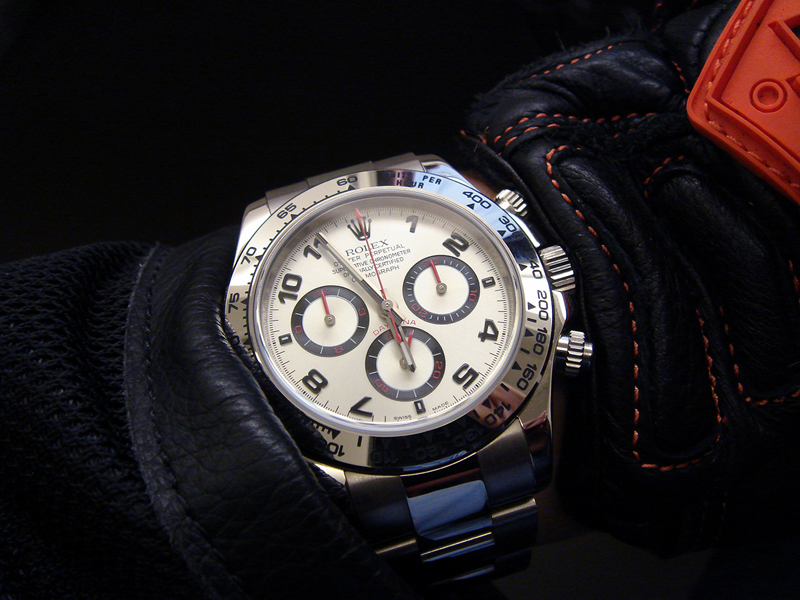
No watch is as closely associated with an actor as the Rolex Daytona is with Paul Newman. His name now designates a type of dial, a price category and one of the most discussed sales in the history of watch auctions. Here is what is documented, what "Paul Newman" Daytonas are really worth, and why they are also forgers' favourite playground.
Paul Newman's watch: what we know
Paul Newman's most famous watch is a steel Rolex Cosmograph Daytona reference 6239, dated 1968. It was given to him by his wife, the actress Joanne Woodward, at the end of the 1960s, when his passion for motor racing was taking shape. The caseback is engraved "Drive Carefully Me". Newman wore it for years, then gave it around 1984 to James Cox, then the boyfriend of his daughter Nell.
On 26 October 2017, at Phillips in New York, this 6239 sold for $17,752,500 including fees, after a dozen minutes of bidding. At the time it was the highest price ever paid for a wristwatch at auction, ahead of a steel Patek Philippe 1518 sold for 11 million dollars the year before. The record has since been beaten, notably by a steel Patek Philippe Grandmaster Chime sold in 2019 at a charity auction. We come back to recent sales in our article on auction records 2025-2026.
A second Newman Daytona confirmed the effect in December 2020: a yellow gold reference 6263, known as "Big Red", engraved "Drive slowly Joanne", sold for $5,475,000 including fees at Phillips in New York. It had been consigned by his daughter Clea.
Why a dial bears his name
The "Paul Newman" dial is not a dial signed by the actor. It is an "exotic" option offered by Rolex on some manual-wind Daytonas of the 1960s and 1970s (6239, 6241, 6262, 6263, 6264, 6265): art deco-style numerals in the sub-dials, small squares at the ends of the graduations, a contrasting colour on the track. His personal watch had one, and, according to the most often told story, it was Italian dealers and collectors in the 1980s who got into the habit of naming these dials after him.
The paradox is well known: at the time, these dials sold poorly. Produced in small quantities, often left in the display case, they became rare precisely because nobody wanted them. Rarity, celebrity and the enthusiasm of the 2010s vintage market did the rest.
2026 value: from the Newman Daytona to the modern Daytona
The figures below clearly separate historic auction results (one watch, one famous owner) from the market ranges we observe for comparable watches. They are not the same objects.
| Watch | Reference | Retail price | Observed value / result |
|---|---|---|---|
| Paul Newman's Daytona (Phillips, 2017) | 6239 steel, Paul Newman dial | discontinued | $17,752,500 including fees |
| Paul Newman's "Big Red" (Phillips, 2020) | 6263 yellow gold | discontinued | $5,475,000 including fees |
| Manual-wind Daytona, authentic Paul Newman dial | 6239 / 6241 / 6262 steel | discontinued | rarely below €150,000, highly variable by condition |
| Automatic "Zenith" Daytona | 16520 | discontinued | €25,000 – €28,000 |
| Ceramic Daytona | 116500LN | discontinued | €24,500 – €30,000 |
| Current Daytona | 126500LN | ~€16,000 | €25,000 – €30,000 |
Two readings stand out. "Newman" provenance multiplies a watch's value by a factor that nothing else justifies: it is a person's object, not a reference. And the modern Daytona's premium over retail, though real, has nothing to do with these figures: it comes from the boutique waiting list, not from the Newman myth. Our article on Daytona market value details it reference by reference.
Three Daytona generations, three movements
To place the prices, a reminder of the chronology helps. The Daytona was born in the early 1960s as a manual-wind chronograph, fitted with a Valjoux-based calibre: these are references 6239, 6241, 6262, 6263 and their neighbours, the only ones concerned by the "Paul Newman" dial. In 1988 came the first automatic Daytona, the 16520, whose calibre 4030 derives from the Zenith El Primero, hence its nickname. In 2000, the 116520 moved to the calibre 4130, entirely designed by Rolex, found in modernised form in the current generation.
Each generation has its market. The manual-wind models belong to collecting and expertise; the "Zenith" has become a safe bet in the middle market; the Rolex automatics trade like current watches, according to the waiting list and retail price increases.
The flip side of the myth: fake dials and reassembled watches
When a dial is worth several times the price of the watch carrying it, it attracts counterfeits. The "Paul Newman" Daytona market is one of the most exposed:
- Refinished dials ("redials"): a standard dial repainted or reprinted to imitate the exotic pattern. Typography, print thickness and the patina of the luminous dots often give the game away, but not always to the naked eye.
- Reassembled watches: a case from one year, a movement from another, a dial from a third. That is the definition of a frankenwatch, and it is common on the most expensive vintage references.
- "Stories" without supporting documents: a watch that "belonged to" someone is only worth what its documents prove. The 2017 and 2020 sales rested on direct, documented family provenance.
For a piece at this level, authentication goes through an independent expert specialising in vintage Rolex or a major auction house, before any payment. The serial number engraved between the lugs must be consistent with the reference, the year and the calibre.
Should you buy a Daytona "for Paul Newman"?
If your budget is that of a modern Daytona, buy a modern Daytona: it is an excellent, liquid watch whose value does not depend on a myth. Reissues and nods to the Newman dial exist at other brands, often for a few hundred or thousand euros; they have their charm but no collector value.
If you are aiming for a real manual-wind Daytona with an exotic dial, think like a collector: condition of the dial, originality of every part, service history, and buying from someone who accepts an independent check. In this segment, it is better to pay a little more for a documented watch than to get "a bargain" on one that is not.
Have a Daytona, vintage or recent, and want to place its value? The Daytona page and the Causli valuation tool give you a range tailored to your reference and its condition.
The model's value: Rolex Cosmograph Daytona

